
– a Q&A forum
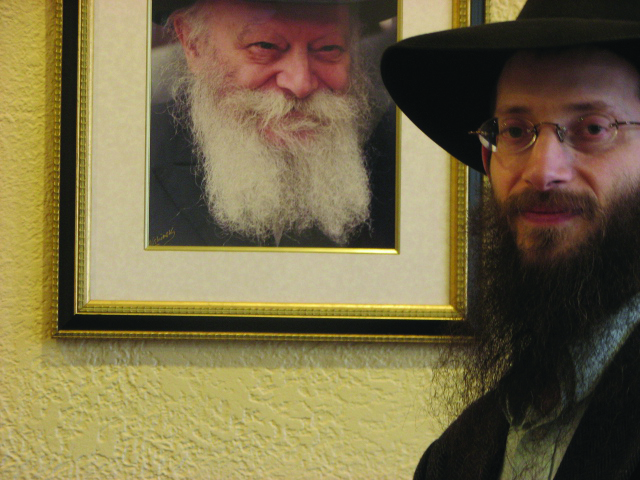
Rabbi Levi Stolik poses with a picture of the Lubavitcher Rebbe
I have heard dire predictions in response to Typhoon Haiyan and other recent natural disasters (in India, Japan, the Peruvian mountains, Guinea, the Australian bush—and in the US—Texas, Colorado, Oklahoma and of course, Hurricane Sandy). An acquaintance told me last week, “G-d is punishing us all!” Well, he scared me. Are we on the verge of apocalypse? Why is the world suffering G-d’s wrath in such large measure these days? What is the Jewish view on these events?
G-d bless you,
Maria
Dear Maria,
I am happy to share my beliefs about G-d’s interactions with the world, but I must first admit that I am not ordained with more prophetic vision than you. In fact, according to the Talmud and other classic Jewish sources, it is not possible for finite beings to understand the ways of an Infinite G-d.
When we don’t know, what is our reaction? The Biblical precedent to global misery is Moses’ reaction to the Egyptian exile: to ask G-d, “Why?” while recognizing that we may never understand. Yet, we refuse to be paralyzed into inaction and believe, as the great 12th century philosopher Maimonides pronounced, “One positive deed will tip the fate of humankind for good” and usher in a time of everlasting peace, free of strife and loss of life.
We are required to bless G-d on the bad as well as the good and to trust, ultimately, in the limitless goodness of G-d. When witnessing an earthquake or a huge storm we say, “Blessed are You, L-rd our G-d, King of the universe, Whose power and might fills the world.” Chassidic texts describe “the bad” as a deeper expression of G-d’s love, but that is a subject that requires deep study outside this venue.
What should we do? Six weeks before major earthquakes hit Iran in 1990, The Lubavitcher Rebbe focused on social action and unity as a means to prevent disaster. To paraphrase: “In truth, G-d provides abundant blessing and created the world with kindness, love and mercy. Would we only share G-d’s bounty among nations in need, thereby averting a huge calamity, such as an earthquake, as a reminder that He controls the world.”
There is no conclusive scientific evidence that natural disasters in general are more prevalent today than throughout history. Why, then, are we more aware of these tragedies today? Through extensive media access, broadcasts are streaming into our homes and hand-held devices. It’s heartening that the news is as filled with relief and aid as the devastation itself. Human acts of kindness are at an all-time high. Our acts of goodness will make the world a better place.
___________________________________________
In the previous issue of the Baruch Light, we invited readers to share with us how they construct an “Iron Dome” to protect themselves from daily bombardment by technology. Here is a selection of responses:
I use the internet to access topics of interest like National Geographic on environmental issues and the forums on StarTrek.com as the loyal, longtime fan I am (yes, I’m a nerd). Managing my “Iron Dome” is a process of scheduling visits and logging into email only twice a day since I have a tendency to write essay-like responses. I limit my time on the web by removing what may not be useful: I switched my homepage from a news site to a search engine, so no ads or headlines—the only prompts are my own brain! These measures save a significant amount of my time reserved for studying and researching my homework.
—Sabirah Abdus-Sabur 2014
Journalism
There are times I long for a simple life, void of extra gadgets and social media outlets. I am much too accessible to the world—anyone can reach me in at least five different ways. I deleted my Facebook for the week during midterms. I was so much more productive!
On the flip side, I really do appreciate technological advancements. There are countless times I think about how lost (literally) I would be without my iPhone apps.
With that said, dearest Technology, I love you but I am sometimes better off without you.
—Ariella Abesera, 2014
Psychology
One of the primary issues I confront is the sheer amount of information that is available on the internet, in classrooms, in the halls of Baruch and in New York City at large. It is exceedingly easy to get lost and not even know that you are lost. I am likely to expend a lot of energy and time unnecessarily.
One of the ways to build an “Iron Dome” to protect myself against bombardment is through my friends. By maintaining mutually beneficial relationships, I develop longer standing ‘story lines’ in my life and I am increasingly able to withstand the pressures put on me by society. It is the warmth of these friendships that I take home each night.
—Barry Polinsky 2014
MPA Policy Analysis
Like anything in excess, technology can become a bad habit. Internet addiction is a real disorder, now listed in the American Psychiatric Association’s (APA) Diagnostic and Statistical Manual of Mental Disorders amongst its compulsive-impulsive disorders like mood disorders (such as depression and anxiety), ADHD and schizophrenia.
Back in March of this semester, I held an “Internet Addiction” workshop for students so that they could be aware of some of the warning signs of addiction. Some of these signs include lying about how much time a student spends playing computer or video games; feeling intense pleasure or guilt when playing computer or video games; spending more and more time playing video or computer games to get the same enjoyment; withdrawing from friends and family; spending a lot on upgrades and more games and thinking obsessively about gaming.
This is an Internet addiction quiz that I recommend all students take so they know their level of risk.
Internet and technology are not inherently bad; it is how we use it that matters. We need to be mindful of our actions and behaviors.
—Megan Aronson CHES, MHE Assistant Director, Health & Wellness
Sources: American Psychiatric Association Committee (2008) Issues for DSM-V: Internet Addiction. American Journal of Psychiatry, vol. 165 #3. Saison, J., Smoth, M., Robinson, L, and Segal, J. (2012). Internet and computer addiction: Signs, sypmtoms, and treatment. Helpguide.com. Wellness USF (2012). Internet Addiction Test. University of South Florida’s Student Affairs.
Q
Rabbi, I am assigned to a major group project (which means a big percentage of my grade!) with three other students here at Baruch. I am very open-minded and I usually love working with all types of students, gaining new perspectives and having all sorts of dialogue. But this time it’s just not happening. There is one guy who is my polar opposite on almost every issue we come across. I don’t know why, but I just can’t get into his headspace at all! I spoke to my mentor and even my professor (that was pretty embarrassing) and they both said something like, “Try to separate the person from his ideas; find something you respect in him…” Well, I really tried. But I can’t respect his opinion on anything and I find myself disagreeing with him on the most trivial things. I need a new perspective, and I hope you can help me.
Gail
Dear Gail,
You have already taken many important steps in resolving your predicament. You have identified the problem and you have made a commitment to change your attitude. You have also searched extensively for a solution and worked hard on trying to implement the advice you received. I understand your frustration in being unable to better your situation, especially since you seem to care deeply about respecting others.
Let me share with you a secret of Jewish mysticism regarding the nature of conflict. When someone dislikes another person intensely, it is common to say, “I can’t stand his or her looks/personality/ideals.” But the real source of this negative feeling is seldom an external or ideological trait; these merely serve as camouflage for the ego. The deeper motive that cultivates animosity is the individual’s need for self-preservation. When a person feels threatened by another, the mind creates myriad excuses for disagreement.
As many nuances as there are to discord, there are ways to combat it. This generally involves a long process of self-evaluation, character development and finding a healthy balance of pride and humility. As you might be looking for a quicker solution (you need to complete your project!), try this: take yourself, meaning your feelings and opinions, out of the picture altogether. Focus on the subject at hand and the greater good that will result from working together.
And before you enter each work meeting, meditate on the following. “I need to focus on what unites rather than what separates us. We share a connection that began way back in Genesis, when G-d said, ‘Let Us make man in Our image.’ By virtue of this likeness, a common G-dly spark, every human being is deserving of respect.” Also, “Everything G-d created, He put into this world to fulfill a unique purpose. Each individual contributes to society something no one else can offer, and is therefore deserving of my respect.”
I have a feeling that once you can make this happen, you will find abundant qualities to appreciate in your new friend. Features such as kindness, emotional strength, work ethic, determination, tolerance, intellect – these all span the spectrum of political, social and religious differences.
Rabbi Levi Stolik
Have support or perspective to offer Gail and others who share her challenges, or you have a question of your own? Post in the comments section here.
Dear Rabbi,
I am a senior, and though we’ve never met, I’ve passed your office on the 3rd floor countless times. I am really struggling with a moral issue and I need your advice. My dad has health issues and has been out of work for a while. I am trying to handle tuition payments on my own and it is a huge burden on top of all my schoolwork. I really need to graduate and get a well-paying job ASAP. I’ve been a real emotional mess with the upcoming final exam season. In one particular class, there have been a lot of problems. The professor is poor at presenting the material and on top of that has shown a lot of favoritism (not to me!) in giving grades. All the classmates I have spoken to agree with me. One guy in the class, who is smart and doing really well, even offered to help me fudge the test. I was always taught that cheating is not moral, and I am pretty uncomfortable doing it, but it seems that it is the only way I will pass the final exam. My parents’ health and sanity and my entire future are at stake. I cannot afford to fail this course and spend another semester in school. Please help me see things clearly.
Thanks,
Janey
Janey, before addressing your dilemma I would like to commend you on your struggle. Unfortunately, in today’s society the mantra seems to be “do whatever you want, just don’t get caught!” You show sincerity and strength of character, even in your stressed-out state.
I would like to suggest some practical ways of solving your problem. Perhaps there are students in the class who have formed a study group and you could join, allowing you to make up some of the material you missed. Your professor may be willing to answer particular questions you have; many professors prove more approachable in person than in a classroom setting. As a last resort, if you truly feel a dispensation is warranted, talk to the department chair and try to explain your particular needs. I encourage you to seek all the support you can get to overcome this challenge. Although cheating may seem a welcome solution, the effort involved in maintaining your integrity will serve you well in the future, even in obtaining and keeping high-level employment.
When speaking of morals, there is a strong case for ethics based on reason. You might personally know many upstanding citizens who are either atheistic or agnostic. Yet, at Sinai, G-d gave the Torah, a system of laws, much of which focuses on our moral and ethical choices. Why? The answer is that a moral system based solely on logic is not absolute, and can be changed based on social norms or personal circumstances.. Yes, your individual issues in life are unique. There are many rationalizations available to excuse cheating under the circumstances. That’s why it’s important to abide by a higher authority and prescribe to an immutable code of what’s right and wrong. Part of human nature is that we are biased toward ourselves, even with the best intentions. So when we need assistance adjusting our moral compass, it is very helpful to turn to a mentor/advisor, or even a good friend, who will be an objective voice.
You are worried about your future. While grades and academics are certainly important – after all, that’s why you’re in school – they are not the key to your career. In fact, your professors would certainly agree that a good education is only the beginning of the journey. It is often the case that it’s “not (only) what you know, but who you know” and being in “the right place at the right time” that are the catalysts for success. Now, while some people may attribute these circumstances to good old-fashioned luck, I prefer to see them as G-d’s blessing. And acting now in a G-dly manner is the surest road there.
Rabbi Levi Stolik
If you have advice, support or other perspectives for Janey and other students who share her challenges, or if you have a question of your own, post your comment below.
Dear Rabbi,
Hi! It’s almost 2012 and it seems that many people are not looking forward to it. Plenty of folk predict that the world will end one way or the other in the coming year. It seems that everyone from Hollywood to NASA to the ancient Mayans have something to say on the issue. Although personally I’m pretty skeptical, these thoughts kind of creep up every once in a while, as when they cause me to question all the effort I’m making in my studies here at Baruch. Whenever I meet you in school, you always have a Torah perspective to share. Is there a Jewish opinion on 2012?
Thanks,
Jacob
Dear Jacob,
Judaism has an opinion on everything – usually more than one, in fact.
Yes, Judaism also predicts that the world will end pretty soon. What is not clear is precisely how soon or to what extent it will end. The ancient sages of the Talmud were masters of law and mysticism. They taught that the world is destined to remain in existence for six millennia from its time of creation. According to their calendar, we are in the year 5772, giving us a little over 200 years before the expiration of the sixth millennium.
The Torah describes six days of creation followed by a Sabbath. Similarly, the six millennia of existence as we know it will precede a sabbatical-like existence. Keep in mind that according to the laws of the Torah, the Sabbath begins early… So, yes, the world will end pretty soon. On a cosmic scale that means right about now. Perhaps just in time for 2012. Something, however, will continue.
Maimonides indicates that our ultimate future is a reward enjoyed by souls unencumbered by bodies. Going along that track, physicality will eventually meet its demise. Nahmanides, conversely, rescues our material universe by teaching that our ultimate future is the reward of souls housed in bodies. Nahmanides is the latter legal authority accepted by Jewish law and his opinion converges with the traditions of Jewish mysticism. It seems our tangible universe is here to stay.
Hassidic teachings explain that the goal of the universe and our purpose within it is not abandonment of corporality, but reconciliation of body and soul. This means a refinement, not an obliteration of physicality and ultimately, a perfect blend of Creator and created. Humankind, as a whole has been working towards this goal since its inception.
The world is ending soon. The negativity of the world, that is. Without the inconsistencies that define life as we know it, we will find ourselves in an entirely different planet and frame of existence. The nature of humans, animals, and even the weather will adapt accordingly, although the more drastic changes may not arrive instantly.
The Torah predicts that this end to history, followed by a better beginning, is right around the corner. And so does global chatter. Global subconscious often mysteriously parallels bursts of spiritual evolution. We suddenly have a $200-million movie, countless online forums and late night radio shows heatedly discussing an imminent end to the world. Even NASA feels compelled to devote significant effort to debunk myths and reassure the public.
It appears as a form of subconscious awakening to a spiritual truth – that the new era, a new universe, is imminent. History has reached its end, not in disaster, but in ultimate relief. Expect sudden rays – of unprecedented G-dly revelation. Anticipate polar shifts – in human conscience and behavior. Prepare for an impact that will shake the planet awake from six millennia of moral and spiritual slumber, with the arrival of the messianic era.
Wake up! It’s almost 2012. Why wait until December of next year? Back in 1991, the Lubavitcher Rebbe urged the world, via a CNN interview, to hasten the arrival of the Messiah with “acts of goodness and kindness.” Do something positive today to end it all now in the best possible way.
* * *
Dear Rabbi,
I’m a very sociable person, and I have many friends here at Baruch. I get pretty uncomfortable, though, when people of certain nationalities approach me, and I am afraid this is because of some ingrained prejudice I learned while growing up. I know this is unacceptable (even though we see it in society all the time), and I try not to express it, but it bothers me that I even feel this way. Can you help me change my attitude?
Respectfully,
S. T.
Dear S.T.,
Ethnic discrimination is a very touchy subject, and you are very brave for bringing it up. Before addressing the topic, I would like to commend you on exercising self-control when faced with this issue. Judaism teaches that “Action is paramount.” (Ethics,1: 17) Keep it up.
Unfortunately, many people exhibit intolerance based on gender, color, nationality, culture, background or even politics. I believe the culprit is the ego. A person’s natural inclination to feel superior can easily lead to finding ways to consider the other as second-rate. There is hope, though.
The Chabad philosophy with which I was raised teaches us that the mind has the ability to rule over our emotions, which includes also our instinctive egotistical nature.
Here’s the perspective: the Talmud warns, “Be humble before every man.” Is this possible? What’s if the other guy’s a criminal? Look a little further, and you’ll find “Don’t judge your fellow until you have reached his/her place”, and you can understand that every person has his or her particular personality, talents, friends, education, etc. and is shaped by these experiences. How do you know how you would react to any particular situation had you been in that “place” (i.e. background)? We all struggle in different ways to fulfill our individual G-d-given mission in this world. Are we applying as much effort as we expect of others? When we understand that we are not in a position to “judge” who falls short or who is more accomplished by G-d’s standard, we have the ability to be humble before every human being and to find something positive to admire and respect.
Good luck putting it into practice!
Rabbi Levi
Good luck putting it into practice!
Rabbi Levi
 The Baruch Light
very nice to hear about this topic.
“When we understand that we are not in a position to “judge” who falls short or who is more accomplished by G-d’s standard, we have the ability to be humble before every human being and to find something positive to admire and respect.”
this is really amazing because I’ve been struggling with feeling different. Sometimes I feel I am not jewish enough and I’ve been feeling so out of place in jewish synagogues and temples even though my mother is Jewish and I know I am jewish. I feel secluded and different. I feel i don’t fit in. any advice? any ideas for me?