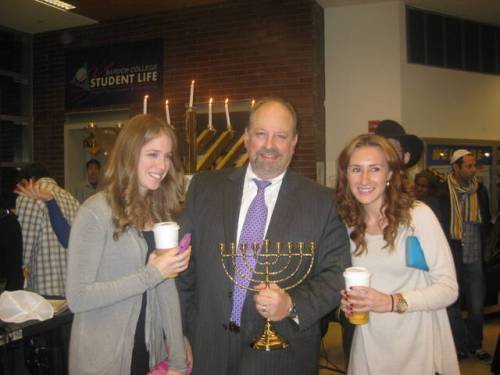
President Wallerstein at a Menorah Lighting Ceremony in 2010
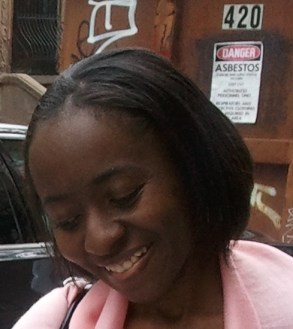
joanna

joanna’s mom
Hi, my name is Joanna Winstars, and I am a Junior studying English Literature at Baruch College.
As a child growing up in a multi-faith home, I was confused when the Menorah was displayed in synagogues year-round, but was only practically significant around the holiday of Chanukah. My mother, who is of Jewish descent, searched for an answer in the Torah. We found it in Exodus 25: 31-32, where it says that G-d commanded Moses to make a lampstand of gold with seven branches to use in the holy Temple, but we found no mention of Chanukah. Our research was cut short, as my father forbade it. But for the past ten years, since our Christian relatives have passed on, my mother and I have been exploring our Jewish heritage and the holidays. One of the first things I chanced upon was an account about the miracle of Chanukah. Now I understand that G-d always answers our important questions.
The Menorah is very spiritually significant to me, so I’ve collected the impressions of my friends– some who were strangers until I approached them! – about this traditional holiday symbol.
Shalom! I’m Rabbi Levi Stolik, the Jewish Chaplain here at Baruch.
The original menorah in the Holy Temple, which we hope will be speedily rebuilt, was intricately carved of a single solid piece of gold out of which seperate branches were formed. Each branch represented the different forms of light found in various character types enumerated by Kabbalistic teaching. Each person is connected to others by virtue of a golden core, a soul, which is capable of illuminating the world by spreading goodness and kindness in a unique way.
I believe that the Menorah is a fitting symbol of Baruch College, highlighting each individual’s strengths as one of the most ethnically diverse schools in the United States.
My name is Gloria Malone. I’m a Junior at Baruch.
I grew up in the Dominican Republic. The first time I heard about the Menorah was on the Nickelodeon show, “The Rugrats.” I learned that the Pickles family is Jewish (I am not) yet I really relate to them. They have these amazing kids. They are awesome. So in my mind, the Menorah is awesome.
My name is Kevin Sanicharra and I’m a Junior at Baruch. I thought about this deeply.
The Menorah means: hope, struggle, achievement. The Menorah’s history portrays the Maccabees, who fought hard for freedom. They were harassed, discriminated against, and forced to assimilate under imperial rule. Judah and his small band of followers persevered with courage, unity, and faith, and a small jug of oil, enough only for one day’s light, lasted through 8 days – a miracle!
Look into the light of the Menorah. Do you truly believe miracles are out there? Do you fill your life with good deeds and stand up for what’s right? If Chanukah happened, remember that with faith, anything is possible.
Professor David Sitt. I teach in the psychology department.
When I see a Menorah glowing in the night, I think of the candle whose flame can give to others without detracting from its own energy. This is an amazing analogy to the power of G-d, His universe, and every individual. We have the capacity to share our joy, kindness, and forgiveness with others. Give someone your smile! We need not be afraid of losing something or diminishing our fire – there is only common gain.
Clara Jackson. I work in the Orientation Office.
The Menorah is a beautiful tradition. When I see it around, it makes me happy.
This is Robbie. I’m a Junior.
The Menorah is our family symbol on Chanukah. We light it every year without fail. Every night we light another candle until all eight are lit. It represents how our ancestors survived Syrian-Greek reign in Ancient Israel.
Hi, I’m Sam Stelzer, a transfer student from the University of Illinois at Champaign-Urbana. I am the president of the Chabad Club here at Baruch.
The Menorah has significant power. Right before the holiday season at my old school, a large tree of many colors, an electronic Menorah and other decorations were displayed in the lobby of my dorm.
On the first night of Chanukah, the Chabad Rabbi set up a little table opposite the display with aluminum Menorahs and birthday candles for any student who wanted to light. In one hour, ten Menorahs were lit; over the next few hours, groups of three, four, and five students came down and lined up to light their candles. I helped them non-stop in setting up menorahs and saying the blessings, and soon the dorm janitor had to set up another table.
As the evening wound down, I marveled that although I attend Friday night services every week at Chabad, I only recognized three or four of those that came to light the Menorah that night. Some students even admitted that this was the only religious practice they took part in all year. I realized that the previous week of facing the tree and the menorah each day in anticipation of the Holiday inspired them to get off their couches, come down to say a blessing and light a candle.
 The Baruch Light